

To understand what Chapchar Kut actually is, you need to understand jhum cultivation. Jhum, also called slash-and-burn or shifting cultivation, is the traditional farming method used across the hills of Northeast India. Farmers clear a patch of hillside forest by cutting down trees and bamboo, leave the vegetation to dry out, then burn it. The ash enriches the soil. They farm the cleared land for one or two seasons before moving on to a fresh patch, allowing the earlier one to recover. The period between the cutting and the burning — when the cleared material is drying and the farmers have some breathing room before the next hard phase — is exactly when Chapchar Kut is observed. It sits in that gap in the agricultural calendar, a rest before things get busy again.
The festival is old. Historians trace its origin to between 1450 and 1700 AD in the village of Suaipui, near present-day Myanmar. Oral tradition says it began when hunters returned to the village empty-handed, and the village chief arranged an impromptu feast with rice beer and meat to make up for the disappointment. The custom repeated itself the following year, and then the year after that, and eventually spread from Suaipui to other villages. It was never a heavily religious festival — it was, from the start, primarily a celebration of community and a chance to rest. That character has stayed with it across five centuries.
The festival had a complicated stretch during the colonial and missionary periods. It declined after the arrival of Christian missionaries in the late 19th century, who discouraged it on religious grounds, largely because of the rice beer and what were considered animistic practices tied to it. Chapchar Kut was first revived on a grand scale in Aizawl in 1962, though it was again briefly discouraged when it was felt the practices did not align with Christian values. It was resumed in 1973 on a mass scale, this time without the animistic elements, but retaining the Cheraw dance and community celebration. Today, Mizoram is one of the most literate and predominantly Christian states in India — over 87 percent of its population identifies as Christian according to Census data — and Chapchar Kut sits comfortably within that cultural context as a celebration of Mizo heritage rather than a religious observance.
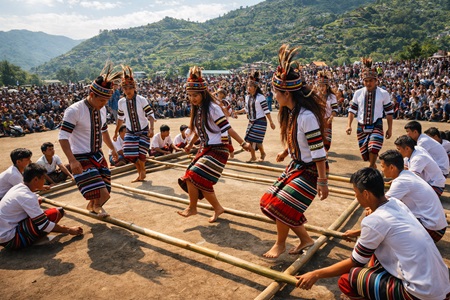
The Cheraw is the dance most associated with the festival, and it deserves its own description. Performers sit on the ground holding pairs of long bamboo poles horizontally, clicking them open and closed in rhythm. Dancers — traditionally young men and women in full Mizo attire — step in and out between the poles with precise, rhythmic footwork, the whole sequence requiring coordination between the pole-holders and the dancers that has to be practiced to look as effortless as it does. The Chai dance, a large community circle dance that traditionally closes the festival, is also traced back to Chapchar Kut. The celebration at Lammual in Aizawl typically involves around 15,000 performers, and most spectators end up joining in — especially for the Chai dance at the end.
The 2026 celebrations ran for a full week. Various programmes were organised throughout the week, including exhibitions of handloom, textiles and handicrafts, a food processing showcase and food court, a flower show, a living museum demonstrating traditional Mizo life, photo and painting exhibitions, and Chapchar Kut film screenings. The main celebration on March 13 was the climax of the week. A large number of tourists from across India and abroad, along with ethnic Mizo communities from neighbouring Northeastern states, attended the festival. Mizoram Governor V. K. Singh (Retd.) was also present. Art and Culture Minister C. Lalsawivunga hosted the event in the role of Kut Thlengtu.
Chief Minister Lalduhoma used his address to speak about the values the festival has historically carried. He said the festival was historically a time for reconciliation and unity, and that customary justice systems in Mizo society practised principles such as “Chalrem” and “Saui Tan.” He stressed that true reconciliation requires the courage to accept responsibility and admit mistakes, and that acknowledging one’s faults without blaming others often leads to peace. He also urged people to be careful about what they post on social media, saying that creating hostility in political discourse is not part of Mizo culture. “Even when disagreements arise in debates or discussions, Mizo society traditionally maintains mutual respect and friendship afterwards,” he said. During the event, Lalduhoma also presented the Chief Minister’s Special Awards to recognise distinguished individuals from the community.
Chapchar Kut is not only celebrated in Mizoram. The Mizo diaspora across the Northeast — particularly in Tripura, Assam, and Manipur — holds its own observances. The 9th State-Level Chapchar Kut 2026 was celebrated in the Jampui Hills of North Tripura, with a large influx of visitors from across Tripura and neighbouring Mizoram. The Jampui Hills have a significant Mizo-origin population, and the festival there has grown into an event that draws visitors well beyond the local community. The Central Young Mizo Association (YMA), one of the most active civil society organisations in Mizoram, was closely involved in the 2026 celebrations, with its president R. Lalngheta encouraging people to practice the theme of Inremna — harmony — in everyday life.
From a tourism and cultural economy perspective, Chapchar Kut has grown steadily in visibility over the past decade. Mizoram’s tourism department has made the festival a centerpiece of its annual calendar, and the Aizawl celebrations now draw visitors from other states and from abroad. The handloom and handicraft exhibitions at the festival give artisans from across Mizoram a platform to reach buyers they would not otherwise encounter. The traditional Puanchei — the colourful Mizo shawl that is both an everyday garment and a marker of identity — sees particular interest from outside visitors during the festival. Mizoram’s handloom sector employs a significant portion of rural women in the state, and events like Chapchar Kut serve as one of the few occasions where that craft gets national exposure.
The jhum cultivation calendar that anchors the festival is itself a subject of ongoing policy and ecological discussion. Jhum as a farming practice has been the subject of debate for decades — environmentalists have raised concerns about forest cover loss and soil erosion, while agricultural researchers and indigenous rights advocates have pointed out that well-managed jhum, with adequate rotation cycles, can be sustainable and supports biodiversity in ways that monoculture farming does not. In Mizoram, where roughly 60 percent of the land is forested and a significant portion of the rural population still depends on agriculture, this is not an abstract conversation. Chapchar Kut, with its direct roots in the jhum calendar, sits at the centre of that discussion simply by existing — a reminder that the festival and the farming practice it marks are inseparable from each other.
Mizoram has a population of approximately 1.1 million according to the 2011 Census, making it one of India’s smaller states by population. But in terms of literacy, it consistently ranks among the top states in the country, with a literacy rate above 91 percent. Chapchar Kut is, in some ways, the state’s most visible cultural export — the images of Cheraw dancers in traditional Puanchei, the packed grounds at Lammual, the community dancing that goes late into the night — and 2026 was no different.
Did You Know? The word “Chapchar” in the Mizo language refers to a flat rock or platform — specifically the kind of resting spot where people would gather and socialise after the exhausting work of forest clearing. “Kut” simply means festival. So the name itself translates to something like “the festival at the resting rock.” Also, the Cheraw bamboo dance of Mizoram was performed at the opening ceremony of India’s Republic Day parade in New Delhi in 2014, introducing the art form to a national audience of millions. Mizoram is one of only three states in India — along with Nagaland and Meghalaya — where over 75 percent of the rural population is engaged in jhum or related forms of shifting cultivation, which is why Chapchar Kut remains not just a cultural event but an agricultural one at its core.