
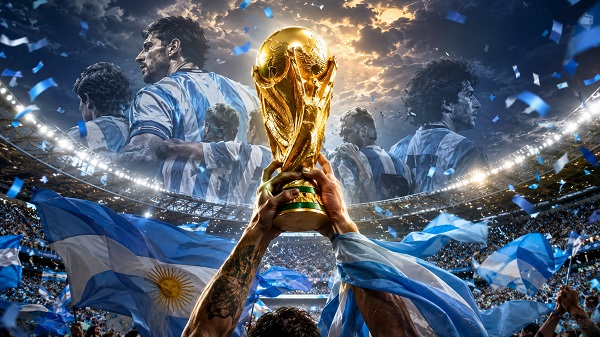

Winning the FIFA World Cup once is enough to make a team immortal.
Winning it twice in a row is almost impossible.
That is the mountain Argentina are trying to climb at the FIFA World Cup 2026. The defending champions arrive in North America with history on their shoulders, Lionel Messi still leading the story, and a squad that already knows what it takes to survive pressure, chaos and expectation.
No men’s national team has defended the World Cup title since Brazil in 1962. That alone makes Argentina’s mission one of the biggest storylines of the tournament.
Argentina are not just chasing another trophy. They are chasing a place in the rarest corner of football history.
Truth Box
| Key Point | Insight |
|---|---|
| Historic target | Argentina can become the first men’s team since Brazil in 1962 to win back-to-back World Cups. |
| Current status | Argentina enter FIFA World Cup 2026 as the defending champions after winning Qatar 2022. |
| Group challenge | Argentina begin in Group J against Algeria, Austria and Jordan. |
| Messi factor | Lionel Messi is part of Argentina’s 2026 squad and is expected to play in his sixth World Cup. |
| Bigger format | The 2026 World Cup has 48 teams, 104 matches and a new knockout path, making the repeat challenge even more complex. |
Why Argentina’s 2026 Mission Feels Almost Impossible
The phrase “back-to-back World Cup champions” sounds simple.
In reality, it is one of the hardest achievements in football.
A World Cup winner spends four years being studied, copied and targeted. Every opponent raises its level. Every mistake becomes bigger. Every selection decision becomes a debate. Every injury creates panic.
Argentina know this pressure well.
After winning the 2022 World Cup in Qatar, they did not fade away. They stayed competitive, added another Copa América title in 2024, and kept much of their champion core together. That makes them dangerous.
But history is not kind to defending champions.
Germany went out in the group stage in 2018 after winning in 2014. Spain crashed early in 2014 after winning in 2010. Italy failed badly in 2010 after lifting the trophy in 2006. France also fell in the group stage in 2002 after winning in 1998.
The pattern is clear.
Winning the World Cup changes a team. Defending it often breaks one.
The History Argentina Are Trying to Break
Only two men’s national teams have ever won consecutive FIFA World Cups.
| Nation | Consecutive World Cup Titles | Years |
| Italy | 2 | 1934 and 1938 |
| Brazil | 2 | 1958 and 1962 |
Since Brazil’s triumph in Chile in 1962, every champion has failed to repeat.
That is more than six decades of failed title defenses.
Argentina now have a chance to join Italy and Brazil in the most exclusive club in men’s World Cup history. For a nation that already has Diego Maradona, Mario Kempes, Lionel Messi and three World Cup titles in its story, this would be another level of greatness.
It would not just be Argentina’s fourth star.
It would be proof that the 2022 team was not a magical one-time run. It would become a football dynasty.
Why Brazil 1962 Still Matters
Brazil’s 1962 win remains the benchmark because they defended the title under difficult conditions.
Pelé, the star of the 1958 World Cup, was injured early in the 1962 tournament. Brazil could have collapsed. Instead, Garrincha, Vavá, Amarildo and the rest of the team carried the country to another title.
That is why Brazil 1962 is still so important for Argentina 2026.
The lesson is not only about talent. It is about depth.
A defending champion cannot rely on one player. Not even Messi. Not even the best goalkeeper. Not even a world-class midfield.
To repeat, Argentina need a squad strong enough to survive injuries, suspensions, tactical changes and emotional pressure.
That is where the 2026 challenge becomes brutal.
The expanded tournament means more teams, more travel, more tactical variety and more chances for chaos.
Argentina’s Strengths Before FIFA World Cup 2026
Argentina do not arrive as sentimental champions. They arrive as serious contenders.
The squad still has a strong spine. Emiliano Martínez gives them elite penalty and big-match presence in goal. Cristian Romero offers aggression and leadership in defense. Rodrigo De Paul, Enzo Fernández and Alexis Mac Allister give balance in midfield. Julián Álvarez and Lautaro Martínez provide goals and pressing up front.
And then there is Messi.
Even if Messi is no longer the same explosive player who destroyed defenses in his younger years, he remains one of football’s greatest problem-solvers. One pass, one free kick, one disguised touch can still decide a knockout match.
Argentina also have something that many talented teams lack.
They have trust.
This group has suffered together, won together and handled finals together. That matters in a World Cup, where pressure often decides as much as tactics.
| Argentina Strength | Why It Matters in 2026 |
| Champion experience | Many players already know how to handle World Cup pressure. |
| Strong goalkeeper | Emiliano Martínez has repeatedly delivered in high-pressure moments. |
| Balanced midfield | Argentina can defend, press and control tempo. |
| Multiple forwards | Álvarez and Lautaro give Scaloni different attacking options. |
| Messi’s creativity | Even in shorter bursts, Messi can unlock tight games. |
| Winning culture | Recent major trophies have built belief inside the squad. |
The Risks That Could Stop Argentina
Argentina’s biggest enemy may not be France, Brazil, England or Spain.
It may be time.
Several leaders from the 2022 squad are older now. Messi is deep into the final stage of his career. Nicolás Otamendi and other senior players bring experience, but age can become a problem across a long tournament.
The second risk is expectation.
In 2022, Argentina were desperate to win for Messi. In 2026, the world expects them to behave like champions. That changes the emotional weight of every match.
The third risk is the new format.
The 2026 World Cup is not the same tournament Argentina won in Qatar. There are 48 teams, 12 groups and a round of 32. More matches can mean more opportunities, but also more traps.
One bad night can undo four years of planning.
| Risk | Why It Could Hurt Argentina |
| Aging core | Older players may struggle with recovery and tournament rhythm. |
| Messi’s fitness | Argentina must manage his minutes carefully. |
| Defending champion pressure | Every opponent will treat Argentina as a statement match. |
| Expanded format | More teams and knockout rounds increase unpredictability. |
| Defensive injuries | Late squad changes can affect chemistry. |
| Overreliance on history | Past success cannot win 2026 matches by itself. |
Argentina’s Group J Path
Argentina begin their title defense in Group J.
Their opponents are Algeria, Austria and Jordan.
On paper, Argentina should be favorites to progress. But World Cup groups are rarely won on paper. Algeria bring physicality and tournament pride. Austria can be disciplined, direct and uncomfortable. Jordan arrive as one of the most interesting underdog stories of the tournament.
This group gives Argentina a clear opportunity to build rhythm.
But it also gives them danger.
A slow start would immediately raise questions. A comfortable start would make the defending champions look frightening again.
Argentina’s opening match against Algeria could set the mood for the entire campaign.
Can Messi Lead One Last World Cup Run?
Messi’s 2022 World Cup felt like the perfect ending.
He scored. He assisted. He suffered. He lifted the trophy. He completed the story that had followed him for almost two decades.
Yet 2026 offers something different.
This is not just about Messi finally winning the World Cup. That chapter is already complete.
This is about whether Messi can help Argentina create a dynasty.
That is why the 2026 version of Messi does not need to be the Messi of 2014 or even the Messi of 2022. Argentina do not need him to carry every minute of every match. They need him to choose moments.
A pass between defenders.
A calm penalty.
A set-piece delivery.
A pause when everyone else is rushing.
That is the value of Messi now. He can slow the game down when the World Cup becomes frantic.
Comparison: Argentina 2022 vs Argentina 2026
| Area | Argentina 2022 | Argentina 2026 |
| Emotional story | Messi chasing his first World Cup | Argentina chasing a historic repeat |
| Tournament format | 32 teams | 48 teams |
| Knockout route | Round of 16 onward | Round of 32 onward |
| Team identity | Hungry, emotional, intense | Experienced, targeted, respected |
| Messi’s role | Central creator and emotional leader | Selective creator and veteran leader |
| Pressure level | Win it for Messi | Prove the era is historic |
| Legacy at stake | End Argentina’s wait | Become the first repeat champions since 1962 |
The 2022 team had hunger.
The 2026 team must show endurance.
That is the difference.
What Argentina Must Do to Repeat as Champions
Argentina do not need to reinvent themselves. They need to adapt.
Their formula is already strong. Compact defending, midfield aggression, emotional unity, elite goalkeeping and Messi’s genius remain a dangerous mix.
But the path to another title demands more than nostalgia.
Argentina must manage Messi intelligently. They must rotate without losing control. They must avoid emotional chaos in heated matches. They must be ruthless against weaker teams and brave against elite ones.
Most importantly, they must prove they are not trapped inside the memory of Qatar.
| Requirement | Why It Matters |
| Start fast in Group J | A strong opening reduces pressure and builds rhythm. |
| Protect Messi’s minutes | Argentina need him sharp for knockout games. |
| Keep midfield control | Their midfield balance is central to their identity. |
| Avoid defensive lapses | Knockout matches often turn on one mistake. |
| Use the full squad | The expanded tournament demands depth. |
| Stay emotionally calm | Defending champions often lose control under pressure. |
Common Misconceptions
Argentina only need Messi to win again
That is not true. Messi can still decide games, but Argentina’s 2022 success was built on the full team. Martínez, Romero, De Paul, Mac Allister, Enzo, Álvarez and Lautaro all matter.
The expanded World Cup makes it easier for big teams
Not always. The 48-team format may give favorites more room in the group stage, but it also adds a round of 32. That creates another knockout hurdle where one bad match can end everything.
Defending champions always have an advantage
They have experience, but they also carry pressure. Recent history shows that defending champions often struggle because opponents study them more closely and expectations become heavier.
Conclusion
Argentina’s 2026 World Cup mission is bigger than defending a trophy.
It is a chance to do what no men’s team has done since Brazil in 1962. It is a chance to turn the Messi and Scaloni era from legendary into almost untouchable. It is a chance to prove that Qatar 2022 was not the peak, but part of something larger.
The challenge is enormous.
The format is bigger. The squad is older. The pressure is heavier. The opponents are ready.
But Argentina have something rare. They have belief, experience, elite talent and the memory of already climbing football’s highest mountain.
Can they do it again?
History says no.
Argentina will believe otherwise.
Frequently Asked Questions
Q1. Can Argentina become back-to-back World Cup champions in 2026?
Ans.Yes, Argentina can do it, but it would be historic. No men’s team has won consecutive World Cups since Brazil in 1962.
Q2. When did Argentina last win the World Cup?
Ans. Argentina last won the FIFA World Cup in 2022, beating France in the final in Qatar.
Q3. Who was the last team to win two men’s World Cups in a row?
Ans. Brazil were the last men’s team to win back-to-back World Cups, winning in 1958 and 1962.
Q4. Who are Argentina playing in the 2026 World Cup group stage?
Ans. Argentina are in Group J with Algeria, Austria and Jordan.
Q5. Is FIFA World Cup 2026 Messi’s last World Cup?
Ans. It could be, but that depends on Messi’s own decision. What is clear is that 2026 gives him another chance to add to Argentina’s already historic era.