
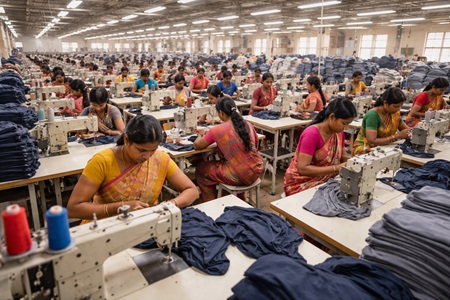

In March 2025 alone, Tamil Nadu exported $687 million worth of textiles — again the highest of any state for that month. The consistency is what makes the number meaningful. This is not a one-quarter spike driven by a single large order. The state has been the top performer month after month, and the NIRYAT data across the full year reflects that pattern.
To understand where these numbers come from, you have to understand the geography. Tamil Nadu’s textile output is concentrated in four cities: Tiruppur, Coimbatore, Erode, and Karur. Each has its own specialisation. Coimbatore handles spinning and weaving. Erode is built around power looms and dyeing. Karur produces home textiles — towels, bed linen, kitchen textiles — that go to retail chains across Europe and North America. And then there is Tiruppur, which is in a category of its own.
Tiruppur is known as India’s Knitwear Capital. It accounts for around 90% of India’s cotton knitwear exports and 55% of all knitwear exports by volume. The city and Coimbatore together — within a roughly 50-kilometre radius — accounted for about 69% of India’s total knitwear exports in FY 2024-25, with a combined value of around Rs 44,747 crore. The clients sourcing from Tiruppur read like a who’s who of global retail: Primark, Tesco, Marks and Spencer, Next, H&M, Walmart, Gap, Carter’s, Decathlon, Target, and Woolworths all place orders here. A T-shirt bought off a rack in a British high street or an American superstore has a reasonable probability of having been stitched in Tiruppur. The Tiruppur Exporters’ Association (TEA) currently lists over 1,100 registered exporters operating from the city.
What makes Tiruppur work at this scale is integration. Spinning mills, knitting units, dyeing facilities, and garment manufacturing are clustered within short distances of each other. A factory in Tiruppur can take raw cotton and turn it into a finished, packaged garment ready for export in under 72 hours. Most competing textile hubs elsewhere cannot match that turnaround. The port of Chennai handles a significant portion of these shipments, and containers from Tiruppur can reach US or EU ports in roughly 12 days — a logistics advantage that matters when global buyers are comparing lead times across sourcing destinations.
The textile sector directly or indirectly employs over 45 lakh people across Tamil Nadu. In Tiruppur specifically, roughly 10 lakh people work in textiles and knitwear, and women make up over 65% of the garment stitching workforce. This is not a small detail. In a region where formal employment for women has historically been limited, the textile industry has created a large, structured workforce. Families where three generations have worked in the same factory or unit are common in Tiruppur. The industry funds schools, clinics, and local commerce in the surrounding semi-urban districts in ways that are not visible in the export data but are very visible on the ground.
The path to the top spot has not been entirely smooth. Tiruppur had a difficult FY 2023-24, with knitwear exports contracting by 14% — a result of weak consumer demand in the US and Europe, the financial pressure from the Russia-Ukraine war on European buyers, and tariff complications in the American market. At one point in late 2025, Tiruppur-based exporters reported a combined daily revenue loss of roughly Rs 60 crore across the cluster, and some factories were running at 30% capacity. R. Rajkumar, managing director of RRK Cottons India, went public about the scale of the difficulty at the time — he had let 1,000 of his 2,000 workers go after $65 crore in confirmed US orders were frozen due to tariff uncertainty. By early 2026, conditions had shifted. Orders from Primark, Tesco, ASDA, Decathlon, and others had returned. The recovery showed in the full-year FY 2024-25 figures.
Looking ahead, the trade environment could shift things considerably. The first phase of a India-US trade agreement and the India-EU Free Trade Agreement are both expected to reduce tariff barriers for Indian textile exporters in their two largest markets. TEA president K. M. Subramanian has said that garment exports from Tamil Nadu to the US — currently around Rs 15,000 crore — could double to Rs 30,000 crore within three years if the trade deals deliver their stated terms. Union Commerce Minister Piyush Goyal has urged Tiruppur’s industry to double exports and generate five lakh additional jobs over the next three years. India’s total textile exports were $36.61 billion in FY25, up from $34.43 billion in FY24. The direction is clear, though the pace of growth depends partly on how quickly the trade agreement terms are implemented.
India’s overall textile export basket in FY 2024-25 was made up of readymade garments ($15.99 billion), cotton yarn, fabrics and handloom products ($12.06 billion), and man-made textiles ($4.87 billion). Tamil Nadu’s contribution runs across all three categories — it produces cotton textiles and garments primarily, but also has units working in technical textiles and industrial fabrics. The state’s export mix includes cotton, silk, handloom products, ready-made garments, and technical textiles used in automotive and medical applications.
The global competition context is also worth noting. Bangladesh has been a major rival for Indian garment exports, particularly in the US and EU markets, benefiting from its Least Developed Country (LDC) status, which gave it preferential duty treatment. Bangladesh is set to graduate from LDC status in 2026, which changes its tariff position. Vietnam and China compete on synthetic fabrics and volume. The India-EU FTA, if it delivers zero-duty access, would narrow the gap between India and Bangladesh significantly in the European market — an opportunity that Tiruppur and the broader Tamil Nadu cluster are well-placed to capture given the existing infrastructure, workforce, and client relationships already in place.
Tamil Nadu’s textile story is, at its simplest, a story about clusters. When spinning, weaving, dyeing, stitching, and logistics are all within a tight geographic radius, the economics of scale compound in a way that is very hard for dispersed manufacturing to match. Gujarat and Maharashtra both have strong textile industries, but neither has the integrated cluster depth that Tamil Nadu built over decades in the Coimbatore-Tiruppur-Erode belt. That depth is what produced $7.99 billion in exports in a single year — and it is what gives the state a durable platform to defend and build on that position.
Did You Know? Tiruppur was once known as a small, unremarkable town in the Kongu Nadu region of Tamil Nadu. The knitwear industry there started modestly in the 1920s with handloom operations. By the 1980s, it had begun exporting, and by the 1990s it had earned the nickname “Dollar Town” — because the volume of US dollar transactions flowing through the city was so large relative to its size. Today, the Tiruppur Exporters’ Association has over 1,100 registered members and the city produces roughly 30,000 tonnes of knitwear every month. Karur, another Tamil Nadu textile hub, is so dominant in home textiles — towels, napkins, kitchen linen — that it supplies an estimated 60% of the world’s cotton terry towel exports. The city is sometimes called the “Textile City of India” for exactly that reason.