
World Water Day was formally established by the United Nations General Assembly in 1993, following a recommendation made at the Earth Summit in Rio de Janeiro in 1992. Since its very first observance, the day has been used to advocate for the sustainable management of freshwater resources and to raise awareness about the 2.2 billion people around the world who currently live without access to safe drinking water, according to the World Health Organization and UNICEF’s Joint Monitoring Programme. Each year, a specific theme guides global conversations, campaigns, and policy dialogues, and the 2026 theme reflects an understanding that water is not simply a resource — it is a social issue, and a deeply gendered one at that.
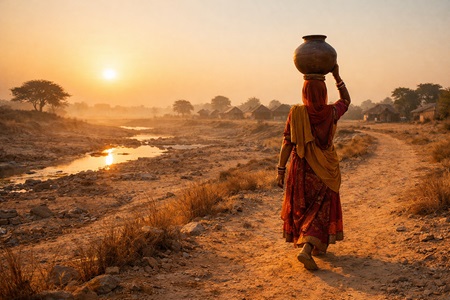
To understand why “Water and Gender” is such a critically relevant theme, the statistics speak for themselves. According to data from UNICEF, women and girls collectively spend approximately 200 million hours every single day collecting water across the globe. That figure is not a rounding error — it is a staggering daily reality for hundreds of millions of households, primarily across Sub-Saharan Africa, South Asia, and parts of Latin America. In these regions, it is overwhelmingly women and girls who are designated as the water-bearers of the family. They walk miles to rivers, ponds, or community boreholes, often before sunrise, carrying loads that can weigh up to 20 kilograms, only to return and repeat the task the next day. This unpaid, unrecognized labour represents one of the most direct ways in which water scarcity translates into gender inequality.
The consequences of this burden ripple out across entire lives. UNESCO data shows that in water-scarce regions, girls are significantly more likely to miss or drop out of school entirely, particularly once they reach adolescence. Without safe water and sanitation facilities within school premises, girls during menstruation are forced to stay home. The UNESCO Institute for Statistics estimates that roughly 1 in 3 schools globally lacks basic drinking water services, and the impact disproportionately affects girls. Lost schooling means reduced literacy, fewer economic opportunities, earlier marriages, and a compounding cycle of disadvantage passed from one generation to the next.
The connection between water and gender, however, is not only about collection burdens. Women are often at the forefront of water management at the household and community level, yet they remain critically underrepresented in the formal decision-making bodies that shape water policy. A 2019 report by the United Nations Water portal found that women account for fewer than 17 percent of water sector professionals in most developing countries. Despite managing water at home every day, women are rarely present at the table when governments, municipalities, and international bodies decide how water infrastructure is built, funded, and maintained. The theme of World Water Day 2026 calls for this gap to be addressed — not only to make policy more equitable, but because evidence consistently shows that when women are included in water governance, outcomes improve for entire communities.
India, home to over 1.4 billion people, has a particularly pressing relationship with this theme. The country is ranked among the most water-stressed nations in the world, with the NITI Aayog having previously warned that India faces one of its worst water crises in history. Groundwater depletion, erratic monsoon patterns attributed to climate change, and rapid urbanisation have all stretched freshwater availability to critical levels in several states. Rural women in states like Rajasthan, Jharkhand, Madhya Pradesh, and parts of Uttar Pradesh continue to walk long distances daily to fetch water, a task that occupies a substantial portion of their productive hours. Government programmes including the Jal Jeevan Mission, launched in 2019 with the goal of providing functional household tap connections to all rural homes by 2024, have made significant strides — the government reported in 2024 that over 14 crore rural households had been connected to tap water under the scheme. However, challenges of water quality, sustainability of supply, and last-mile connectivity still remain in focus for policymakers and development workers alike.
On a global scale, the United Nations 2030 Agenda for Sustainable Development includes Sustainable Development Goal 6 (SDG 6), which specifically commits to ensuring availability and sustainable management of clean water and sanitation for all. Embedded within SDG 6 are targets that explicitly address gender — including ensuring access to adequate and equitable sanitation and hygiene for all, with special attention to the needs of women and girls. Yet the UN’s own 2023 SDG progress report flagged that the world is significantly off-track on SDG 6, with current rates of progress insufficient to meet global targets by 2030. Climate change is being cited as one of the major accelerators of this regression, as rising temperatures intensify droughts, floods disrupt water infrastructure, and glacial retreat threatens freshwater sources that entire populations in countries like Nepal, Peru, and Pakistan depend upon.
The 2026 observance of World Water Day is also being linked to the upcoming UN 2026 Water Conference, which is expected to be a landmark moment for reviewing commitments made at the 2023 UN Water Conference in New York — the first such conference in nearly five decades. At the 2023 conference, governments, civil society groups, and the private sector made over 700 voluntary commitments amounting to hundreds of billions of dollars toward water-related goals. Progress monitoring on these commitments forms a significant part of the global water agenda as 2026 approaches, and the “Water and Gender” theme serves as a reminder that these pledges must be translated into ground-level change for the communities most affected.
World Water Day is observed with events, art installations, community drives, policy workshops, and digital campaigns across more than 100 countries. In India, various government bodies, NGOs, and educational institutions mark the occasion with awareness drives, cleanliness campaigns around water bodies, and plantation activities near rivers and lakes. Schools use the day as an opportunity to educate students about conservation, with activities ranging from rainwater harvesting demonstrations to art competitions on water themes. This year, the “Water and Gender” theme is expected to generate focused conversations around women’s roles in water management, menstrual hygiene and sanitation, and the need for gender-sensitive water policies at every level of governance.
Fresh water covers less than 3 percent of the Earth’s total water, and of that, only about 0.5 percent is accessible for human use through rivers, lakes, and shallow groundwater. As global demand for fresh water continues to rise — driven by population growth, agricultural needs, and industrial expansion — the resource becomes not just a survival question but a justice question. Water and gender, as a theme, recognises that justice around water cannot be achieved without simultaneously addressing gender inequality, and that gender equality cannot be fully achieved as long as women and girls bear the disproportionate cost of water insecurity.
March 22 is more than a calendar date. It is an annual reminder that every conversation about climate change, food security, public health, and economic development must include a conversation about water — and every conversation about water must include women.
Did You Know? The first World Water Day was celebrated on March 22, 1993 — over three decades ago. Since then, themes have ranged from “Water for Cities” (2011) to “Valuing Water” (2021) to “Accelerating Change” (2023). The 2026 theme “Water and Gender” follows the 2025 theme “Glacier Preservation”, highlighting a growing shift in UN water advocacy toward addressing climate vulnerability and social equity together. Also, the word “water” appears in the Indian Constitution as a Directive Principle of State Policy under Article 47, which directs the State to raise the level of nutrition and standard of living and improve public health — where access to safe drinking water plays a central role.